
E-commerce has become one of the most competitive online landscapes. With thousands of stores launching every year and product discovery shifting toward search engines, SEO in eCommerce is no longer optional; it’s a necessity.
Today, over 63% of all online shopping journeys begin with a Google search. Even if customers discover a product from an ad or social media, they often search again on Google to compare prices, read reviews, and explore alternatives.
This makes one thing very clear:
If your online store isn’t visible in search results, you’re losing sales to competitors.
SEO
- drives long-term traffic,
- improves brand visibility,
- increases conversions,
- reduces dependency on ads,
- and scales your store sustainably.
Whether your store runs on Shopify, WooCommerce, Magento, BigCommerce, or any platform, this guide will help you understand how SEO works, how to optimize your store, and how to build a future-ready organic growth strategy.
Are you running your Ecommerce store on WooCommerce platform? Use the Discount Rules Pro plugin to create advanced discounts and boost sales.
Table of contents
- SEO
- What is SEO in E-Commerce?
- Why SEO Optimization Matters for Ecommerce Stores?
- Is it Worth Investing in SEO for an eCommerce Business?
- How Search Engines Rank eCommerce Websites?
- How to Research and Find Keywords for Your Ecommerce Website?
- 4 Key Pillars of Ecommerce SEO
- 1. On-Page Ecommerce SEO
- 2. Technical Ecommerce SEO
- 3. Content Strategy for eCommerce SEO
- 4. Authority Building: Getting Backlinks
- SEO for eCommerce Product Pages
- How to Optimize Your Ecommerce Business for Local SEO?
- eCommerce Site Architecture: Best Practices
- eCommerce SEO Strategy Framework for 2026
- Common eCommerce SEO Mistakes to Avoid
- Best eCommerce SEO Tools
- Future Trends in eCommerce SEO
- WooCommerce SEO Optimization (Special Section)
- Conclusion
- Frequently Asked Questions
What is SEO in E-Commerce?
SEO in ecommerce is the process of optimizing your online store so search engines can understand, rank, and recommend your pages to customers searching for relevant products.
Unlike normal websites, eCommerce stores have:
- multiple product pages
- complex navigation
- dynamic inventories
- filter-based URLs
- duplicate content challenges
- similar product variations
- large image files.
This creates both opportunities and risks.
When optimized properly, your store becomes easier for customers and search engines to understand.
Why SEO Optimization Matters for Ecommerce Stores?
SEO isn’t just about ranking — it directly impacts sales, brand authority, and customer trust.
- Higher Visibility for Product Pages: Your products appear when people search for:
- “best running shoes for flat feet”
- “affordable gaming laptops”
- “buy organic skincare online.”
SEO matches your products to buying-intent searches.
- Better Quality Traffic: SEO attracts customers with high purchase intent, unlike social media traffic, where users are passively scrolling.
- Lower Customer Acquisition Costs: Paid ads get expensive. SEO keeps bringing customers without constant spending.
- Higher Conversion Rates: Optimized pages:
- load faster,
- look cleaner,
- give better information,
- and help buyers make decisions quickly.
- 24/7 Promotion: SEO works even when you sleep. And you don’t need to spend the AD budget.
- Strong Competitive Advantage: Even small stores can outrank big brands with better SEO if the above-mentioned four pillars are strong.
Is it Worth Investing in SEO for an eCommerce Business?
Yes — without question.
SEO is one of the only long-term growth strategies proven to scale eCommerce brands sustainably.
You benefit if:
- Your product margins are tight
- Competitors dominate paid ads
- Your store needs organic, long-term traffic
- You want consistent sales without rising ad costs.
SEO brings customers consistently without increasing acquisition costs.
How Search Engines Rank eCommerce Websites?
Google uses hundreds of ranking factors, but for eCommerce, these matter the most:
1. Relevance: Does your page match the search intent?
2. Quality: Is your content unique, useful, and descriptive?
3. Technical Health: Does your site load fast? Does it have errors? Is it mobile-friendly?
4. User Experience Signals: Do people stay on your page? Do they click around? Do they convert?
5. Trust and Authority: Backlinks, mentions, reviews, and brand presence.
Google aims to show the most helpful product or page; your job is to make your store the most helpful one.
How to Research and Find Keywords for Your Ecommerce Website?
Keyword research is the foundation of SEO for ecommerce websites.
Instead of guessing what buyers search for, you strategically target keywords that align with purchase intent.
These are the 4 keywords categorized by customers’ search intent.
1. Informational Keywords: Used for learning
Customers search these terms to know or learn something.
For example, “how to choose a treadmill,” “shoe size conversion guide.”
Use these keywords for blog content.
2. Commercial Keywords: Used for comparisons
When customers want to purchase something, they use these search terms to identify the best brand or store.
For example, “best laptops for students,” “top waterproof jackets 2025.”
Use these keywords for category pages & buying guides.
3. Transactional Keywords: Used by ready-to-buy shoppers
When customers are ready to buy products, they use an exact search term to find the right products.
For example, “buy noise-cancelling headphones,” “iPhone 14 case online.”
You can use these keywords for product pages.
4. Navigational Keywords: Brand-specific
When customers know what website to visit, they search for these terms.
For example, “Zara women’s dresses,” “Boat earphones price.”
You can use these keywords for brand pages.
Finding High-Converting Keywords for Your Store
Use tools like:
- Ahrefs
- SEMrush
- Google Keyword Planner
- Ubersuggest
Look for:
- Keywords with 300+ monthly searches
- Low to medium competition
- Clear buying or commercial intent.
For instance, instead of targeting “laptop”, target: “best lightweight laptops for travelers.”
Competitor Keyword Gap Analysis
Find out:
- What keywords are your competitors ranking for?
- What pages bring them traffic?
- What are you missing?
This helps you outrank them by improving or creating similar pages.
4 Key Pillars of Ecommerce SEO
Let’s discuss the four key components of SEO for your Ecommerce site:
- On-Page SEO: optimizing content, keywords, and structure.
- Technical SEO: improving speed, crawlability, and structure.
- Content SEO: optimizing blogs, guides, and comparison pages.
- Authority Building: Getting backlinks, reviews, and brand signals.
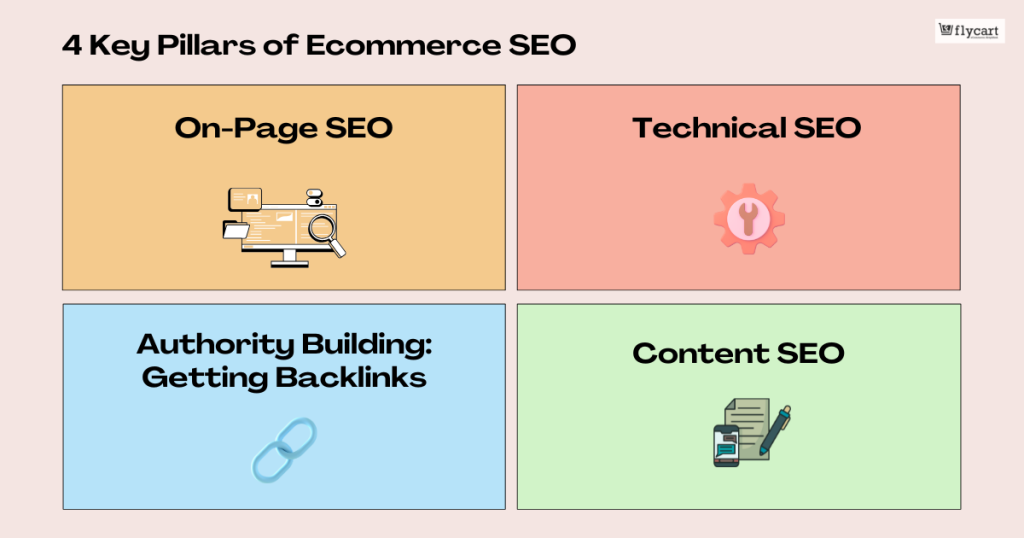
When all four work together, your store becomes a search engine magnet.
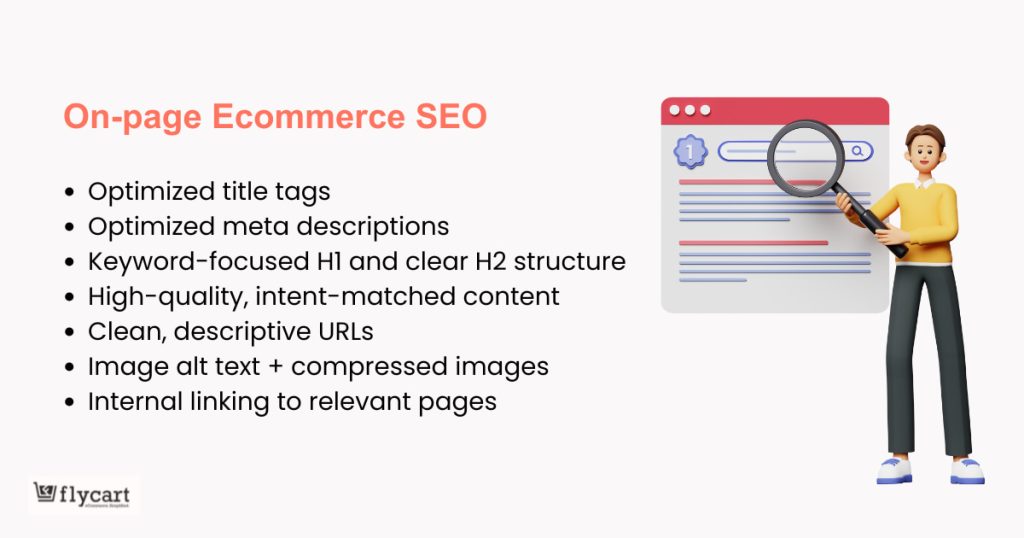
1. On-Page Ecommerce SEO
On-page SEO helps your product and category pages rank higher and convert better. When optimized correctly, these pages attract qualified shoppers who are ready to buy.
The goal is to make every page easy for search engines to understand and valuable for users to navigate.
A. Optimizing Category Pages (Your Highest-Converting Pages)
Category pages usually bring the most organic traffic because shoppers search for broad terms like “women’s running shoes” or “office chairs.”
- Adding a short 150–250-word intro helps search engines understand what the page is about while giving shoppers clarity.
- Use SEO-friendly H2 tags to structure subcategories clearly, such as “Trail Running Shoes” or “Neutral Running Shoes.”
- Ensure your filters and URLs are clean and keyword-friendly to support better crawling.
- Link internally to your best-selling or high-margin products to drive conversions.
- Meta titles should be descriptive and match search intent; avoid generic titles.
B. Optimizing eCommerce Product Pages (Where Conversions Happen)
A great product page does two things: ranks well and convinces shoppers to buy.
- Start with an SEO-friendly title that includes the brand, key features, and target keyword. This helps you appear for specific product-intent searches.
- Write a detailed 300–600-word description covering what the product is made of, how it works, who it’s for, and why it’s worth buying.
- Include benefits and care tips to boost buyer confidence.
- Bullet points help skimmers quickly understand key features.
- Reviews, FAQs, and user-generated content add trust and improve SEO.
- High-quality images and videos enhance engagement and support visual search indexing.
C. Internal Linking Strategy for eCommerce
Internal links strengthen your site structure, improve crawl depth, and guide shoppers to relevant pages. This boosts both SEO authority and conversions.
Link category pages to subcategories, subcategories to products, and products to related items to keep users moving through your store.
Don’t forget your blog: articles can link back to relevant products to capture research-stage visitors and turn them into buyers.
Most importantly, make sure no page is left disconnected.
2. Technical Ecommerce SEO
Technical SEO ensures your online store runs smoothly, loads fast, and can be properly crawled and indexed by search engines.
Without strong technical foundations, even the best product pages won’t rank or convert effectively.
This section focuses on the backend elements that keep your site healthy and visible.
A. Crawlability & Indexation
Crawlability determines whether search engines can access your pages, while indexation decides whether those pages appear in search results.
- Regularly audit your robots.txt file, XML sitemap, and parameter or pagination URLs to ensure they are set up correctly.
- Review which pages are indexable and which should be blocked.
The goal is simple — make sure your important category and product pages are never accidentally restricted from search engines.
B. Page Speed Optimization
A slow eCommerce store directly impacts both rankings and sales.
Shoppers expect pages to load almost instantly, and every second of delay increases bounce rates.
- Improve site speed by compressing images, enabling lazy loading, optimizing caching, and minimizing CSS/JS files.
- Also, ensure your server responds quickly.
As a rule, your store should consistently load in under two seconds.
C. Fixing Duplicate Content & Canonicals
Duplicate content is a major issue in eCommerce because product variations, filters, or manufacturer descriptions often create multiple similar URLs. This weakens rankings and confuses search engines.
- Use canonical tags to point Google to the main version of a page,
- Apply “noindex” to thin or low-value pages, and
- Write unique descriptions for high-performing products.
This keeps your content clean and consolidated.
D. Mobile-First Optimization
Since 70%+ of shoppers browse and buy on mobile, optimizing for smaller screens is essential.
- Ensure your layout is fully responsive, buttons are easy to tap, and filters are simple to use on touch devices.
- Compress images so they load quickly on mobile data.
With Google using mobile-first indexing, your mobile experience directly influences your rankings.
E. Structured Data for Products
Structured data helps search engines understand your products and display enriched results (rich snippets).
- Add schema markup to show ratings, prices, stock availability, and FAQs directly on search pages.
This increases visibility, improves click-through rates, and provides shoppers with useful information before they even land on your website.

3. Content Strategy for eCommerce SEO
Content is one of the strongest growth levers for eCommerce brands. It brings qualified traffic, builds topical authority, and guides shoppers through their buying journey.
A strong content strategy supports both ranking and conversions by educating customers before they make a purchase.
A. Blogging for eCommerce
Blogs help your store rank for informational keywords: the questions and searches users make before they’re ready to buy.
These articles attract new visitors, help solve customer problems, and position your brand as an expert.
Use blog posts to internally link to relevant categories and product pages, boosting their SEO strength.
The goal is to answer search intent clearly while naturally guiding readers back to your store.
B. Buying Guides & Comparison Pages
Buying guides and comparison pages are high-intent content formats that attract shoppers who are close to making a purchase.
These articles help customers choose between brands, understand product features, and compare options based on needs and budget. Because the reader is already in decision mode, these pages often deliver excellent conversion rates.
They also reduce purchase hesitation by giving clear, structured recommendations.
C. Topic Clusters for Authority
Topic clusters organize your content in a way that shows Google you’re an authority on a subject.
Start with a main “pillar” guide and link it to multiple related subtopics, then connect those subtopics to your product or category pages. This structure improves internal linking, strengthens topical relevance, and helps search engines understand your expertise.
Over time, this increases visibility across every keyword related to that topic.

4. Authority Building: Getting Backlinks
Link-building helps increase your website’s authority, making it easier for your product and category pages to rank higher on Google.
In eCommerce, backlinks act as trust signals; the more credible sites linking to you, the more search engines view your store as reputable.
A balanced link-building strategy boosts visibility, traffic, and long-term SEO results.
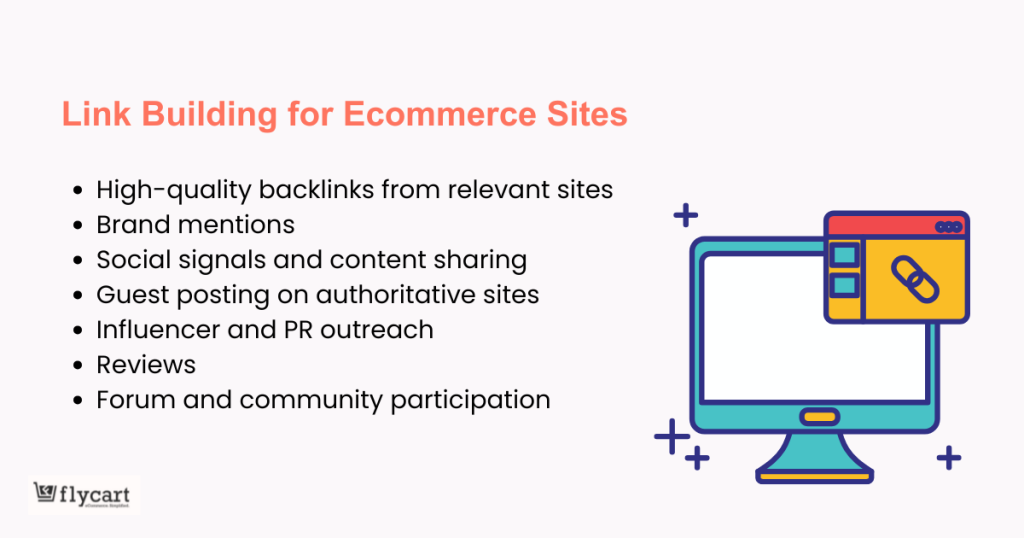
A. Effective Link-Building Methods
Strong, ethical link-building focuses on earning backlinks from relevant, high-quality websites.
- Guest posting on niche blogs helps you reach targeted audiences while gaining contextual links.
- Influencer reviews allow creators to showcase your products and naturally link to your store.
- Product sponsorships and brand PR create organic mentions from media publications.
- You can also run an affiliate program to encourage bloggers and content creators to promote your products in exchange for commissions.
B. Avoid Harmful Link Practices
Not all links are good for SEO.
- Spam links or irrelevant blog comments can harm your site.
- Focus on earning genuine, authoritative links rather than trying shortcuts that risk your entire domain.
SEO for eCommerce Product Pages
Product pages are the heart of your eCommerce store — this is where the sale happens.
Optimizing them not only improves search visibility but also boosts conversions.
A well-structured product page helps search engines understand your content while giving shoppers the confidence to buy.
Schema Markup
Schema markup helps search engines understand key product details such as ratings, pricing, and availability.
Adding structured data increases the chances of appearing in rich results, which can significantly improve click-through rates.
With schema, your product listings stand out visually in search results, making them more appealing to potential buyers.
Customer Reviews
Search engines trust user-generated content because it signals authenticity and product reliability.
Encouraging photo reviews, customer Q&A, and verified ratings adds depth to your product pages. It improves both SEO and conversions by showing real experiences from real customers, helping shoppers feel more confident in their purchase.
Conversion Boosters
Small elements on a product page can greatly influence buying decisions.
- Trust badges reassure customers about payment and security.
- Clear, prominent CTAs guide them toward checkout.
- Fast, distraction-free checkout flows reduce abandonment.
- Crisp bullet-style highlights help shoppers understand product benefits quickly.
Together, these elements create a smooth and confidence-building buying experience.
How to Optimize Your Ecommerce Business for Local SEO?
If your eCommerce brand also has physical stores, pickup points, or warehouses, local SEO becomes essential.
Local optimization helps nearby customers discover you through searches like “electronics store near me” or “fashion store in Bangalore.” It also strengthens your online presence for local-intent keywords.
- Start by optimizing your Google Business Profile with accurate business details, images, operating hours, and customer reviews.
- Add local keywords to your landing pages, such as “shoe store in Chennai” or “best toy shop in Delhi.”
- Build local citations by listing your business on trusted regional directories.
eCommerce Site Architecture: Best Practices
A clear, simple site structure makes it easier for both search engines and users to navigate your store.
When pages are organized logically, your site becomes more crawlable, improving indexation and overall SEO performance.
Clean architecture also reduces friction for shoppers, leading to better engagement and conversions.
The best structure for eCommerce stores is straightforward:
Home → Category → Subcategory → Product
This hierarchy keeps URLs clean and ensures users can reach any product in just a few clicks.
Avoid deep folders, overly complex navigation menus, or multi-step URLs that confuse both users and search engines.
A streamlined structure improves crawl efficiency and boosts the visibility of your most important pages.
eCommerce SEO Strategy Framework for 2026
A structured SEO plan ensures your eCommerce store grows sustainably and stays competitive.
This framework guides store owners through practical, step-by-step actions to improve visibility, attract more traffic, and increase conversions.
1: Run a Sitewide SEO Audit
A thorough audit identifies both quick fixes and long-term priorities, giving you a roadmap for improvement.
- Start by evaluating your entire website to uncover issues that may prevent it from ranking.
- Check for indexing problems, slow page speed, thin or duplicate content, and duplicate URLs.
2: Fix High-Impact Technical Issues
Address the most critical technical problems first, as they directly affect SEO performance.
Focus on removing duplicate pages, improving slow-loading pages, and implementing proper schema markup.
Fixing these issues ensures that search engines can crawl and index your site efficiently, and that users have a smooth browsing experience.
3: Optimize Category First, Then Product Pages
Category pages often drive the most organic traffic, so optimize them first with clear headings, descriptions, and internal links.
Once categories are strong, enhance product pages with unique titles, detailed descriptions, high-quality images, and reviews. This approach maximizes the SEO impact of your top-performing pages.
4: Create Content Around Your Products
Content marketing supports SEO and guides buyers through the purchase journey.
Create blogs, buying guides, comparison pages, and FAQs that answer questions, educate customers, and link naturally to your product pages.
A well-structured content builds authority, improves rankings, and warms up shoppers before they buy.
5: Build Authoritative Backlinks
Backlinks are a key factor in search rankings.
Focus on earning links from relevant niche blogs, influencers, and reputable PR sites.
High-quality backlinks signal authority to search engines, increase referral traffic, and enhance the credibility of your eCommerce store.
6: Track Performance
Monitoring metrics ensures your strategy is effective.
Track search impressions, click-through rates (CTR), product rankings, and category performance.
Regular analysis lets you spot trends, identify areas for improvement, and adjust your strategy to maximize results over time.
Common eCommerce SEO Mistakes to Avoid
Identifying and fixing these SEO issues can dramatically improve your store’s visibility, user experience, and conversions.
Here are the most common pitfalls store owners should watch out for:
- Duplicate product descriptions: Using the same text for multiple products hurts rankings. Write unique descriptions.
- Slow website: Heavy images and scripts slow your store down. Speed directly impacts SEO.
- No product schema: Without a schema, Google can’t show rich results like price or ratings.
- Missing image alt-tags: Alt text helps search engines understand your images and boosts visibility.
- Weak internal linking: Poor linking makes it hard for Google to find and rank important pages.
- Thin category page content: Category pages need short intro content to rank. Avoid empty grids.
- Keyword stuffing: Overusing keywords looks spammy and lowers rankings.
- Ignoring mobile experience: Most shoppers use mobile. A bad mobile layout kills conversions and SEO.
Best eCommerce SEO Tools
Use these tools to run audits, find keywords, fix technical issues, and improve rankings quickly.
- Ahrefs: Great for keyword research, competitor analysis, and backlink audits.
- SEMrush: All-in-one toolkit for tracking rankings, site audits, and SEO insights.
- Screaming Frog: The best crawler for finding technical issues like duplicate pages and broken links.
- Google Search Console: Free tool to monitor indexing, impressions, clicks, and page performance.
- PageSpeed Insights: Checks website speed and gives suggestions to improve loading time.
- RankMath / Yoast: Helps optimize on-page SEO elements within WordPress and WooCommerce.
- SurferSEO: Useful for optimizing content structure based on top-ranking pages.
Future Trends in eCommerce SEO
1. AI-Driven Search Behaviors
Google is increasingly showing AI-generated answers and summaries. This means eCommerce stores must publish authoritative, high-quality content to stay visible and trusted.
2. Visual Search Optimization
With tools like Google Lens growing, shoppers now search using photos. Optimizing product images, alt-tags, and structured data becomes crucial for visual discovery.
3. Voice Search & Conversational Queries
More users search through voice assistants. Product pages and blogs must target natural, conversational phrases and question-style keywords.
4. Zero-Click Search
Google often answers queries directly on the results page, reducing clicks. Your content must be unique, helpful, and deeper than what Google’s snippets provide.
5. First-Hand Experience Content
Google now prioritizes content created with real product usage or hands-on experience. Authentic reviews, expert insights, and UGC help you stand out.
If you run your eCommerce store on the WooCommerce platform, you can check the details below!
WooCommerce SEO Optimization (Special Section)
WooCommerce gives store owners full flexibility, but it requires proper SEO tuning to perform at its best.
With the right setup, your store can load faster, rank higher, and convert more visitors into customers.
Simple improvements in structure, speed, and content can dramatically enhance your WooCommerce SEO performance.
Improve Key WooCommerce SEO Elements
- Clean URLs: Use short, descriptive URLs without extra parameters to help search engines and users understand your pages easily.
- Schema Markup: WooCommerce doesn’t automatically generate full product schema. Adding structured data helps display ratings, prices, and availability in rich results.
- Mobile Speed: WooCommerce stores can become heavy with plugins. Focus on compressing images, reducing unused scripts, and improving mobile load times.
- Caching: Caching plugins significantly boost performance by reducing server load and speeding up repeated visits.
- Product Descriptions: Avoid generic or short descriptions. Write unique, benefit-focused content to improve keyword targeting and conversions.
Recommended Plugin for WooCommerce Stores
If you want to increase conversions, boost order value, and run smarter deals for shoppers, use “Discount Rules for WooCommerce – Flycart.”
This plugin allows you to create advanced discount strategies without coding. It’s perfect for turning SEO traffic into more revenue.
You can set up:
These features help store owners reward shoppers, reduce cart abandonment, and increase average order value — making it an essential add-on for WooCommerce growth.
If you are a beginner to the WooCommerce platform, here are a few guides to help you get started:
- Create a WooCommerce Store in WordPress: 5 Simple Steps
- 25+ Best WooCommerce Plugins to Start Your Online Store
- How to Add a WooCommerce Discount to Increase Sales? (7 ideas)
- Two Ways to Create Discount Coupons in WooCommerce Stores
Create advanced discounts and coupons using the Discount Rules Pro plugin for a WooCommerce store and increase AOV by up to 41%.
Conclusion
SEO in eCommerce is no longer optional; it’s the foundation of long-term growth.
With millions of products competing online, the stores that win are the ones that invest in clean site structure, fast performance, high-quality content, and consistent optimization.
By improving your category pages, product pages, technical setup, and link-building efforts, you make your store more visible and trustworthy for both shoppers and search engines.
As we move into 2026, the role of AI, visual search, real product experiences, and mobile optimization will only grow stronger.
Brands that adapt early will enjoy compounding results: more traffic, more authority, and higher conversions.
Whether you’re running a WooCommerce store or scaling an established eCommerce brand, strong SEO is the smartest long-term investment you can make.
Also Read:
- 10 Types of eCommerce Marketing Your Online Store Should Follow
- Much Needed Marketing Plugins to Achieve eCommerce Success
- Why Customers Are Not Buying in Your eCommerce Store
- How Social Proof Plays a Major Role in eCommerce Conversions?
Frequently Asked Questions
Most stores see noticeable improvements within 3–4 months, with stronger, compounding results after 6–12 months of consistent optimization.
Start with category pages, then optimize product pages, as these deliver the most organic traffic and conversions.
AI summaries, visual search, voice queries, and first-hand experience content are shaping how users discover products. Adapting early gives you a competitive edge.
The golden rule of SEO is:
“Create content that satisfies the user’s search intent better than anyone else.”
Everything in SEO: keywords, backlinks, technical fixes, site speed, and content depth ultimately supports this one principle.
Yes. Compressed images with descriptive alt-text help with speed, accessibility, and ranking in Google Images, an important traffic source for product discovery.
Reviews add natural keywords, fresh content, and trust signals, improving both rankings and conversions.
They can. Use strategies like:
– Keeping the page live.
– Adding “notify me.”
– Suggesting alternatives.
This keeps the page indexed and useful to search engines.
Yes. Videos improve engagement, reduce bounce rate, and can rank in Google Video search results.