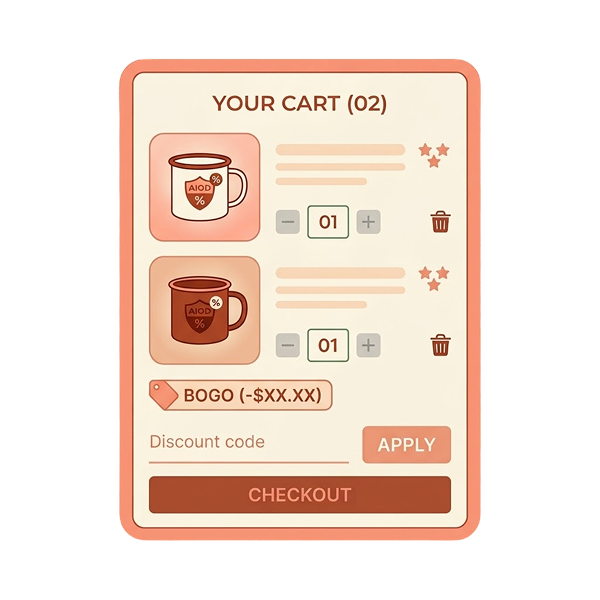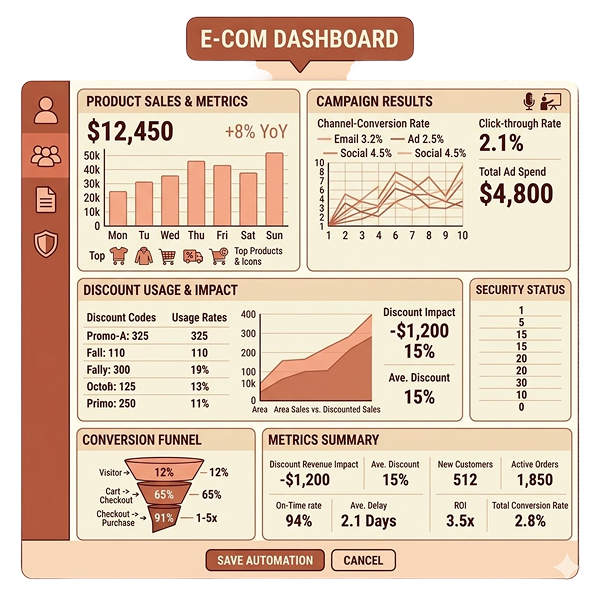

Ecommerce automation has become a powerful growth lever for online businesses that want to reduce costs while handling increasing order volumes smoothly.
As ecommerce stores expand, manual work often grows faster than revenue. Consequently, teams spend more time managing orders, updating spreadsheets, responding to customers, and coordinating shipping. This is exactly where ecommerce automation changes the equation.
By automating repetitive tasks, store owners gain time, accuracy, and predictable operations.
Moreover, automation for ecommerce allows businesses to replace fragmented workflows with connected systems.
Instead of manually transferring data between tools, an automated ecommerce store runs on predefined rules and triggers. Orders move from checkout to fulfillment, marketing, and support with minimal human intervention.
As a result, operational costs decrease, while customer experience improves.
This blog explores how ecommerce automation reduces costs and manual work across operations, marketing, and fulfillment.
Additionally, it explains how even a simple ecommerce business can adopt ecommerce process automation step by step.
If your goal is to automate your ecommerce operations without complexity, this guide will help you move forward with clarity.
Automate your WooCommerce discounts the smart way.
Try “Discount Rules for WooCommerce – Pro” and create powerful, rule-based discounts that run automatically without manual updates.
Table of contents
- What is Ecommerce Automation and How It Works?
- Key Cost Centers Reduced by Ecommerce Automation
- Automation for Ecommerce Operations: From Orders to Fulfillment
- Ecommerce Marketing Automation That Lowers Acquisition Costs
- Workflow Automation in Ecommerce: Building Efficient Ecommerce Workflows
- Ecommerce Process Automation for Scaling Without Extra Staff
- How to Automate a Simple Ecommerce Business: A Practical Workflow Blueprint
- Choosing the Right Ecommerce Automation Software and Platform
- WooCommerce Automation in Action: Smart Discounts and Marketing
- Benefits of Building a Fully Automated Ecommerce Business
- Conclusion: Start Small and Automate Your Ecommerce Growth
- Frequently Asked Questions
What is Ecommerce Automation and How It Works?
Ecommerce automation refers to using software, rules, and integrations to perform ecommerce tasks automatically instead of manually. These tasks include order processing, inventory updates, customer messaging, discount application, and marketing follow-ups.
At its core, ecommerce automation connects different systems so data flows seamlessly across your business.
An automated retail commerce setup typically relies on triggers and actions.
For example, when a customer places an order, the system can automatically update inventory, send an order confirmation, notify the shipping partner, and trigger a follow-up email. This entire flow runs without manual intervention, saving both time and labor costs.
Automation for ecommerce works through ecommerce automation software or an ecommerce automation platform. These platforms integrate with your store, CRM, payment gateways, shipping tools, and marketing systems.
Once configured, they execute tasks based on predefined conditions. Therefore, your ecommerce workflow becomes predictable and scalable.
Importantly, ecommerce automation does not remove human involvement entirely. Instead, it allows teams to focus on strategic tasks such as growth planning, customer experience, and optimization.
By removing repetitive work, businesses reduce burnout and operational errors.
For WooCommerce stores, ecommerce automation is especially accessible. With plugins and integrations, even small businesses can automate discounts, marketing campaigns, and customer communications.
Over time, this leads to a more stable and cost-efficient ecommerce operation.
Key Cost Centers Reduced by Ecommerce Automation
Ecommerce automation directly impacts several major cost centers within an online business.
- Labor costs are often the most obvious. When teams manually handle order updates, customer follow-ups, and inventory tracking, expenses rise quickly. Ecommerce automation replaces much of this repetitive work with rule-based execution.
- Additionally, error-related costs decrease significantly. Manual data entry often leads to mistakes in shipping addresses, pricing, or inventory counts. Ecommerce process automation ensures consistent execution, reducing refunds, returns, and customer complaints. Consequently, businesses save money while protecting their brand reputation.
- Marketing expenses also benefit from ecommerce marketing automation. Automated campaigns target the right audience at the right time, reducing wasted ad spend.
For example, abandoned cart emails or personalized discounts run automatically, improving conversion rates without increasing marketing team size.
- Another important area is software sprawl. Without automation, businesses often rely on disconnected tools and manual coordination.
Ecommerce automation platforms consolidate workflows, reducing the need for multiple overlapping systems. This simplification lowers subscription costs and administrative overhead.
Overall, ecommerce automation transforms cost structures from variable and reactive to predictable and optimized.
By investing in automation early, businesses gain long-term cost efficiency while maintaining operational flexibility.
Automation for Ecommerce Operations: From Orders to Fulfillment
Operational automation is one of the most impactful applications of ecommerce automation.
From the moment a customer places an order, multiple processes begin.
-> Without automation, these steps require constant manual monitoring.
-> With automation for ecommerce, they run smoothly in the background.
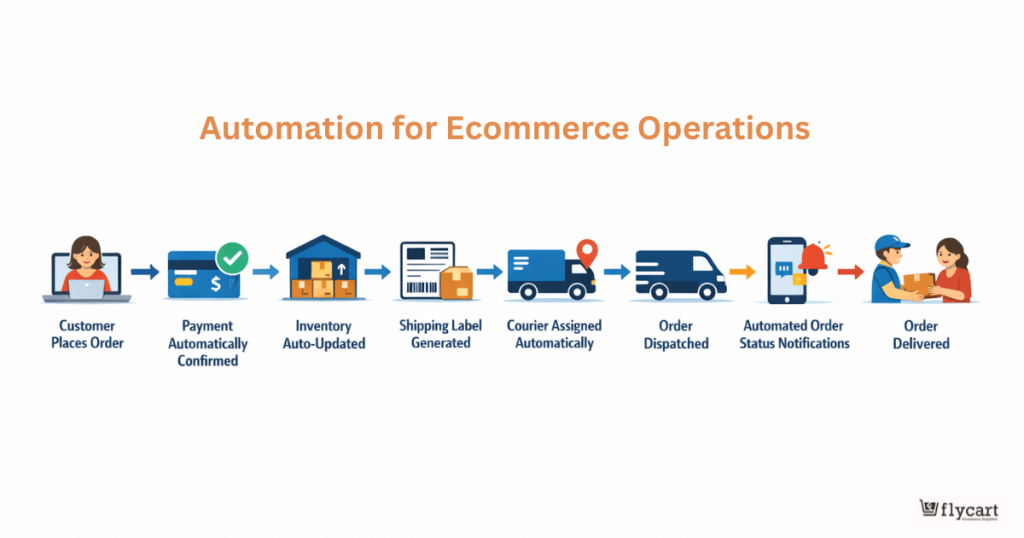
Order processing can be fully automated by connecting checkout systems with inventory and shipping tools.
- As soon as an order is placed, stock levels update automatically, preventing overselling.
- Simultaneously, shipping labels and tracking numbers can be generated without manual input.
- Shipping management is another area where ecommerce automation shines. Automated ecommerce stores integrate with courier services to assign shipments based on location, cost, or delivery speed.
- Customers receive automated notifications for order confirmed, dispatched, and delivered stages. This reduces support tickets and builds trust.
- Returns and refunds also benefit from ecommerce workflow automation.
- Automated return rules can trigger refunds, restocking, and customer updates instantly. As a result, teams spend less time resolving routine issues.
By automating operational workflows, ecommerce businesses achieve faster fulfillment, fewer errors, and lower staffing requirements.
Over time, this operational efficiency becomes a competitive advantage.
Ecommerce Marketing Automation That Lowers Acquisition Costs
Ecommerce marketing automation focuses on delivering the right message to the right customer at the right time.
Instead of running manual campaigns, automation uses customer behavior to trigger personalized communication. This approach improves engagement while lowering acquisition and retention costs.
(A) Email and WhatsApp automation are common starting points.
For example, automated welcome messages, order confirmations, and post-purchase follow-ups keep customers informed without manual effort.
Additionally, abandoned cart reminders recover lost sales automatically.
This is where an email marketing automation software like Retainful comes into play.
Built mainly for both WooCommerce and Shopify platforms (and works for other ecommerce platforms), this tool helps you automate not only your email campaign but also helps you automate SMS, WhatsApp message campaigns, and also helps you manage omnichannel ecommerce workflow.
You can simplify your email marketing process with automation software and focus on your products or other business parts.
(B) Discount automation is another powerful tactic.
Automated rules apply discounts based on cart value, customer segment, or purchase frequency. This not only saves manual effort but also ensures pricing consistency.
Ecommerce marketing automation tools help test and optimize these offers continuously. By combining ecommerce automation with data-driven marketing, businesses reduce ad dependency and maximize lifetime value. Over time, this creates a sustainable growth engine that operates efficiently.
The discount automation plugin for WooCommerce integrates seamlessly with store data. Purchase history, browsing behavior, and order value can trigger targeted campaigns.
As a result, promotions feel relevant rather than intrusive, increasing conversion rates.
Here are a few automatic discount creation guides for WooCommerce stores:
- How to Automatically Add a WooCommerce Free Gift with Purchase?
- How to Set Up Customer-Specific Discounts in WooCommerce?
- How to Create a WooCommerce User Group Discount?
- How to Create New User Coupons in WooCommerce?
Build a scalable WooCommerce store without extra effort.
Use Discount Rules for WooCommerce – Pro to automate offers, personalize pricing, and grow revenue while reducing manual work.
Workflow Automation in Ecommerce: Building Efficient Ecommerce Workflows
Workflow automation in ecommerce focuses on connecting tasks across departments into a single, logical flow, rather than isolated actions.
Ecommerce workflows guide orders, data, and communication through predefined paths. This structure reduces confusion and manual coordination.
An effective ecommerce workflow starts with mapping existing processes. For instance, order placement, payment confirmation, fulfillment, and support should follow a clear sequence.
Ecommerce automation then assigns responsibilities and triggers actions automatically at each stage.
Data management improves significantly with workflow automation. Customer details, order history, and communication logs are stored centrally. This eliminates duplicate data entry and ensures teams always access accurate information.
Furthermore, workflow automation enhances accountability. Automated logs and status updates make it easy to track progress and identify bottlenecks. As a result, managers can optimize processes proactively.
For growing businesses, ecommerce workflow automation provides consistency. Even as order volume increases, workflows remain stable. This stability allows teams to scale without proportional increases in staffing costs.
Ecommerce Process Automation for Scaling Without Extra Staff
Ecommerce process automation enables businesses to scale operations without hiring large teams. By automating end-to-end processes, businesses handle higher volumes efficiently. This approach is essential for sustainable growth.
Processes such as invoicing, tax calculation, inventory replenishment, and customer onboarding can all be automated. Ecommerce automation software ensures these processes run consistently, regardless of order volume.
As order volumes rise, manual handling of tasks like invoicing, inventory updates, customer follow-ups, and reporting becomes expensive and error-prone. Ecommerce process automation replaces these repetitive tasks with rule-based systems that operate consistently, regardless of volume.
The core idea here is leverage: instead of hiring more people to manage growth, automation allows existing teams to handle more work efficiently.
How to Automate a Simple Ecommerce Business: A Practical Workflow Blueprint
Many ecommerce businesses operate with simple workflows, yet still spend excessive time on repetitive tasks.
Automation helps streamline these workflows without forcing major changes to how the business runs. The key is to automate what already exists, not rebuild everything from scratch.
- Start with sales and customer communication. If your business uses calls or messages to close orders, a basic CRM can automatically log customer interactions, store call notes, and schedule follow-ups.
- Once a customer confirms a purchase, automated payment links can be triggered instantly, reducing delays and manual coordination.
- After payment, customer details can be captured automatically into a centralized system instead of relying on separate forms and spreadsheets.
- Order fulfillment
- Orders can automatically trigger shipping requests, assign courier partners, and generate tracking information.
- At the same time, customers receive automated messages such as order confirmed, dispatched, and delivered. This reduces inbound support calls while improving customer confidence.
- Post-delivery support can also be automated. Once delivery is confirmed, tasks such as installation support or onboarding demos can be automatically assigned to the relevant team.
- Notifications ensure no customer is missed, even as order volume grows.
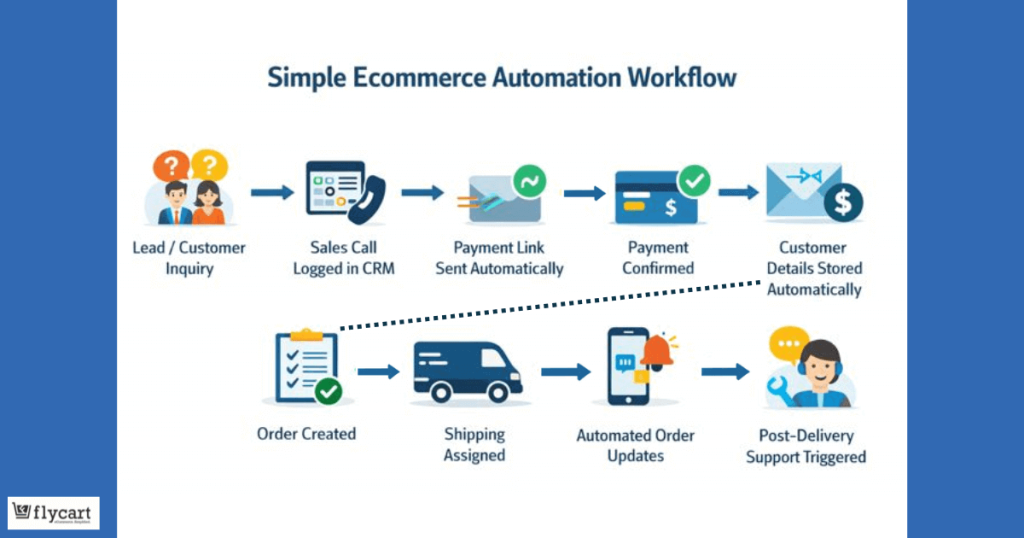
By automating one step at a time, a simple ecommerce business becomes faster, more organized, and easier to scale. These small improvements compound over time, creating a smooth ecommerce workflow without complexity.
Choosing the Right Ecommerce Automation Software and Platform
Selecting the right ecommerce automation software determines how effective your automation efforts will be in the long run.
Rather than focusing on the number of features, store owners should focus on how well the platform fits their actual workflow.
Integration is the most important factor. The automation platform should connect easily with your ecommerce store, payment gateways, shipping tools, and marketing channels.
Seamless integrations reduce manual work and prevent data silos, which are common causes of operational delays.
Rule-based automation is another essential requirement. A good ecommerce automation platform allows you to define clear conditions and actions.
For example, when an order reaches a specific value, when a customer belongs to a certain segment, or when a product category is added to the cart. This flexibility allows automation to feel personalized rather than generic.
Scalability should also be considered early. As order volumes increase, your automation software should handle more workflows without slowing down or requiring frequent upgrades.
Reliable performance ensures that automation supports growth instead of creating bottlenecks.
For WooCommerce store owners, WooCommerce-native tools often offer the best experience. They are designed around WooCommerce workflows, require less setup, and reduce compatibility issues.
Choosing the right platform from the beginning ensures your ecommerce automation remains efficient, flexible, and future-ready.
WooCommerce Automation in Action: Smart Discounts and Marketing
Discounts are one of the most effective tools in ecommerce marketing, yet they are often managed manually.
WooCommerce automation transforms discounts from time-consuming tasks into strategic, automated systems that run smoothly in the background.
With rule-based automation, discounts can be applied automatically based on cart value, product combinations, customer roles, or purchase history. This ensures pricing consistency while eliminating manual updates. Customers see the right offer at the right moment, improving conversion rates and order value.
This is where “Discount Rules for WooCommerce – Pro” by Flycart plays a key role.

The plugin allows store owners to create advanced discount rules once and let them run automatically.
Whether it is bulk pricing, BOGO offers, seasonal promotions, or customer-specific discounts, everything executes based on predefined conditions.
WooCommerce marketing automation becomes more effective when discounts align with customer behavior.
Automated discounts can support email campaigns, abandoned cart reminders, and loyalty programs without extra effort.
As a result, marketing teams save time while delivering highly targeted promotions.
By automating discounts and promotions, WooCommerce stores reduce errors, improve efficiency, and create a more predictable revenue system. This makes ecommerce automation practical, measurable, and directly tied to business growth.
Benefits of Building a Fully Automated Ecommerce Business
A fully automated ecommerce business operates with clarity, consistency, and control.
Instead of managing daily tasks manually, store owners rely on systems that execute workflows automatically. This shift delivers long-term benefits across the entire organization.
- One of the biggest advantages is cost efficiency. Automation reduces dependency on large teams for routine operations such as order processing, customer updates, and reporting. As a result, businesses improve margins while maintaining service quality.
- Customer experience also improves significantly. Automated order confirmations, shipping updates, and follow-ups ensure customers stay informed at every stage. This consistency builds trust and reduces support queries.
- Automation enhances decision-making by centralizing data. Real-time insights into sales, inventory, and marketing performance help store owners respond quickly to trends. Instead of reacting to problems, businesses optimize proactively.
- Team productivity increases as well. Employees focus on strategy, creativity, and customer relationships rather than repetitive tasks. This leads to better outcomes and higher job satisfaction.
Ultimately, a fully automated ecommerce business is easier to manage, easier to scale, and more resilient to change. Automation becomes the foundation for sustainable growth rather than a short-term efficiency fix.
Still managing discounts and promotions manually?
Save time, avoid pricing errors, and boost conversions by automating your WooCommerce pricing strategy with Discount Rules for WooCommerce – Pro.
Conclusion: Start Small and Automate Your Ecommerce Growth
Ecommerce automation is not about replacing people or overhauling your entire business overnight. It is about making everyday operations smoother, faster, and more reliable.
By automating repetitive tasks such as order processing, customer communication, shipping updates, and marketing campaigns, ecommerce businesses reduce costs while gaining the flexibility to grow.
The real advantage of ecommerce automation lies in its scalability. When workflows are automated, growth no longer depends on adding more staff or increasing manual effort.
Instead, systems handle volume consistently, allowing business owners to focus on strategy, customer experience, and long-term planning. Even simple ecommerce setups benefit when small processes are automated step by step.
For WooCommerce store owners, automation becomes even more accessible. Tools designed specifically for WooCommerce fit naturally into existing workflows and reduce setup complexity.
Pricing and promotions, in particular, become far more effective when discounts are automated based on customer behavior and cart conditions.
The best approach is to start with one or two high-impact areas, measure results, and expand gradually.
Over time, these small improvements compound into a streamlined, cost-efficient ecommerce operation.
By choosing the right automation tools and applying them thoughtfully, ecommerce automation becomes a growth enabler rather than a technical challenge.
Also Read:
- How to Build a Scalable Omnichannel Ecommerce Strategy?
- 10 Helpful AI Tools for eCommerce Stores to Boost Revenue
- 5+ Best Marketing Automation Plugins for WooCommerce
Frequently Asked Questions
Yes, ecommerce automation is especially useful for small businesses. Even basic automation helps reduce errors, save time, and manage growth without increasing staff.
Automation reduces labor costs, minimizes errors, improves operational efficiency, and lowers dependency on manual processes, which together reduce overall operating expenses.
WooCommerce supports automation through plugins and integrations that simplify tasks such as discounts, marketing, order updates, and customer communication.
Start with repetitive tasks that consume the most time, such as order notifications, discounts, or customer follow-ups. Gradually expand automation as your business grows.
Most modern ecommerce automation tools are designed for non-technical users. Many platforms use rule-based settings and simple interfaces, allowing store owners to set up automation without coding or developer support.
Results can appear quickly, especially when automating high-impact areas like order notifications, discounts, or follow-ups. Many businesses notice time savings and fewer errors within the first few weeks.
Yes, ecommerce automation improves retention by delivering timely communication, personalized offers, and consistent experiences. Automated follow-ups and targeted discounts help keep customers engaged after their first purchase.