
Every successful online store reaches a moment where short-term wins are no longer enough.
At that stage, sustainable progress depends on a clearly defined ecommerce growth strategy that supports long-term expansion rather than temporary spikes.
Instead of chasing quick traffic boosts or one-time promotions, growing brands focus on systems that scale marketing, pricing, customer experience, and retention, working together.
A strong ecommerce growth strategy helps businesses move confidently from experimentation to execution. It aligns product decisions, customer acquisition, and revenue optimization under a single vision.
As a result, store owners gain clarity on where to invest, what to test, and how to grow without exhausting budgets or teams.
At the same time, competition in ecommerce continues to intensify. Customers now expect seamless shopping experiences, personalized pricing, and consistent value across every interaction.
Therefore, growth is no longer about doing more; it’s about doing the right things at the right time.
This guide walks you through a practical, scalable approach to ecommerce growth.
You’ll learn how to build an ecommerce business development strategy, apply proven ecommerce growth tactics, and identify growth opportunities that compound over time.
Whether you’re running a WooCommerce store or planning expansion across markets, this article is designed to help you grow with confidence, structure, and measurable results.
Start experimenting with tools today! Use Discount Rules for WooCommerce – Pro to create smart discounts that increase conversions instantly.
Table of contents
- What is an Ecommerce Growth Strategy?
- Core Elements of a Sustainable Ecommerce Business Development Strategy
- Customer Research as the Foundation of Ecommerce Growth
- Product and Pricing Optimization for Scalable Growth
- Conversion Optimization as a Growth Strategy for Ecommerce
- Marketing Channels That Support Long-Term Ecommerce Expansion
- Retention-Focused Ecommerce Growth Tactics That Compound Over Time
- Data, Analytics, and Experimentation for Smarter Growth Decisions
- Growth Hacking Strategies for Ecommerce Brands
- Planning an Ecommerce Expansion Strategy for Global Markets
- What’s Your 2026 Ecommerce Growth Plan?
- How WooCommerce Store Owners Can Scale Faster with Smart Discounts?
- Conclusion: Turning Strategy into Sustainable Ecommerce Growth
- Frequently Asked Questions
What is an Ecommerce Growth Strategy?
An ecommerce growth strategy is a structured plan that outlines how an online business attracts customers, increases revenue, and expands operations sustainably.
Rather than relying on isolated tactics, it connects marketing, operations, pricing, and customer experience into one unified growth framework.
At its core, a scalable growth strategy for ecommerce focuses on repeatability. It prioritizes actions that can be refined, automated, and optimized over time.
For example, improving conversion rates, increasing average order value, or strengthening retention programs often delivers more impact than chasing new traffic endlessly.
Additionally, an ecommerce growth strategy adapts as the business evolves.
Ecommerce Growth Ideas vs Strategies
Early-stage stores may focus on validation and traffic acquisition, while mature brands shift toward optimization, expansion, and profitability. Because of this, flexibility becomes a key part of long-term growth planning.
Importantly, growth strategies differ from growth ideas.
While ecommerce growth ideas spark innovation, a strategy turns those ideas into prioritized actions with measurable outcomes. It defines goals, identifies constraints, and sets benchmarks that guide decision-making across teams.
When executed correctly, a well-designed ecommerce growth strategy reduces risk. It helps store owners avoid scattered efforts and focus on what actually moves the needle. Ultimately, this clarity enables consistent progress, even as customer behavior, platforms, and markets continue to change.
Core Elements of a Sustainable Ecommerce Business Development Strategy
A strong ecommerce business development strategy is built on interconnected elements that support both revenue and long-term brand value.
Each element plays a role in ensuring growth remains predictable and scalable.
- First, market positioning establishes how your brand stands out. Clear differentiation helps customers understand why they should choose you over competitors. Whether it’s pricing, quality, service, or experience, positioning influences every growth decision that follows.
- Next, customer acquisition channels must align with profitability goals. While paid ads can drive quick wins, organic channels, partnerships, and referrals often deliver higher lifetime value. Therefore, balancing short-term performance with long-term sustainability is critical.
- Another essential component is operational readiness. Growth often exposes inefficiencies in inventory, fulfillment, and support systems. Preparing these foundations early prevents friction as order volume increases.
- Pricing and promotions also play a vital role. Strategic discounting, bundles, and dynamic pricing models can accelerate growth without eroding margins. When managed carefully, these tactics become powerful levers within your ecommerce growth strategy.
- Finally, measurement and feedback loops tie everything together. Data-driven insights allow teams to refine strategies continuously. Over time, this structured approach transforms growth from reactive experimentation into deliberate, scalable execution.
Customer Research as the Foundation of Ecommerce Growth
Every successful ecommerce growth strategy begins with deep customer understanding.
Knowing who your customers are, what motivates them, and how they shop enables smarter decisions across marketing, product development, and pricing.
- Customer research goes beyond demographics!
Behavioral insights, such as browsing patterns, purchase frequency, and cart abandonment reasons, offer valuable clues about growth opportunities.
For instance, understanding why customers hesitate at checkout can unlock conversion improvements without increasing traffic.
- Additionally, qualitative feedback adds context to quantitative data. Reviews, surveys, and support conversations reveal emotional drivers that numbers alone cannot explain. These insights often inspire impactful ecommerce growth ideas that resonate more authentically with buyers.
- Segmentation further strengthens growth efforts. By grouping customers based on behavior or value, businesses can personalize messaging, promotions, and experiences. This targeted approach increases relevance and improves ROI across campaigns.
Ultimately, customer research aligns growth initiatives with real needs. Instead of guessing what might work, store owners build strategies grounded in evidence.
Over time, this customer-centric approach becomes a competitive advantage that fuels sustainable expansion.
Product and Pricing Optimization for Scalable Growth
Product and pricing decisions directly influence the scalability of any ecommerce business. When optimized strategically, they become powerful drivers within an ecommerce growth strategy.
Product optimization starts with clarity. Clear descriptions, high-quality visuals, and compelling value propositions reduce friction and build trust. Additionally, identifying best-selling products helps focus marketing efforts on high-impact SKUs.
Pricing optimization, meanwhile, balances competitiveness with profitability. Rather than static pricing, dynamic approaches, such as volume discounts, bundles, or tiered offers, encourage higher order values. These methods also support various ecommerce growth tactics aimed at increasing revenue per customer.
Testing plays a key role here. A/B testing different price points or bundle structures reveals what resonates most with your audience.
Over time, these insights inform a scalable pricing framework aligned with business goals.
Importantly, promotions should support long-term growth rather than undermine perceived value.
Strategic discounting tied to behavior, seasons, or customer segments delivers results without conditioning shoppers to wait for sales.
When product and pricing optimization work together, they create a growth engine that scales efficiently, supporting both customer satisfaction and revenue growth.
Conversion Optimization as a Growth Strategy for Ecommerce
Conversion optimization transforms existing traffic into measurable growth.
As part of a broader growth strategy for ecommerce, it delivers high returns with relatively low investment.
The checkout experience often presents the biggest opportunity. Streamlined flows, transparent pricing, and trust signals reduce friction and boost completion rates. Even small improvements here can significantly impact revenue.
Product pages also influence conversions. Clear calls-to-action, social proof, and detailed information guide customers toward confident decisions. Over time, refining these elements becomes a repeatable growth process.
Additionally, personalization enhances conversion performance. Showing relevant offers or recommendations based on browsing behavior increases engagement and order value. These tailored experiences align closely with modern ecommerce growth tactics.
Conversion optimization is not a one-time task. Continuous testing and iteration ensure that improvements scale alongside traffic growth.
As a result, businesses achieve sustainable gains without relying solely on increased acquisition.
What Are the Best CRO Tests for High-Traffic Product Pages?
High-traffic product pages are goldmines for conversion optimization (CRO) testing. Small improvements here can dramatically impact revenue.
CRO tests for these pages should focus on reducing friction, improving clarity, and increasing urgency.
- Start with A/B testing headlines and product descriptions. Clarity and benefit-oriented messaging can significantly boost conversions.
- Next, test CTA placement, color, and text, as these often influence clicks.
Product images and videos are also key: testing multiple images, 360-degree views, or demo videos can increase user confidence.
- Other valuable tests include trust signals such as reviews, ratings, and security badges.
Experimenting with urgency tactics like limited-time offers or low-stock indicators can also motivate purchases.
For high-traffic pages, testing checkout button positioning, guest checkout options, and payment method visibility often yields substantial results.
- Finally, segment tests by traffic source, device type, or customer segment to identify what works best for different users.
Continuous monitoring and iterative testing ensure that CRO improvements compound over time, providing both immediate and long-term revenue gains.
Marketing Channels That Support Long-Term Ecommerce Expansion
Marketing fuels visibility and demand, making it a cornerstone of any ecommerce expansion strategy.
However, scalable growth requires channel diversification rather than dependence on a single source.
- Organic channels such as SEO and content marketing build authority over time. They attract high-intent audiences while reducing long-term acquisition costs.
- Paid channels, meanwhile, offer speed and scalability when managed strategically.
- SMS and Email marketing strengthen customer relationships. These owned channels support retention, upselling, and repeat purchases and become key drivers of sustainable growth.
- Social and influencer partnerships add credibility and reach. When aligned with brand values, they amplify awareness and support expansion into new markets.
Ultimately, successful marketing strategies integrate channels into a cohesive system. This balanced approach ensures that growth remains resilient even as algorithms, costs, and platforms evolve.
Related Read: 10 Types of eCommerce Marketing Your Online Store Should Follow
How to Optimize Long-Tail Keywords for Ecommerce SEO?
Long-tail keywords: specific search phrases with lower volume but higher intent, are critical for driving qualified traffic to ecommerce stores. Optimizing for these terms improves your chances of ranking for buyers who are ready to purchase.
- Begin by conducting keyword research with tools like Ahrefs, SEMrush, or Google Keyword Planner. Look for long-tail variations related to your products, such as “organic cotton men’s t-shirts” instead of just “t-shirts.”
- Next, integrate these keywords into product pages, titles, meta descriptions, and image alt text naturally. Avoid keyword stuffing; focus on readability and context.
- Content creation also matters. Blog posts, buying guides, FAQs, and category pages can target long-tail queries, providing value while improving SEO. Internal linking strengthens relevance, connecting product pages with relevant content.
- Finally, track keyword performance and optimize based on engagement and conversion metrics.
Long-tail optimization is particularly effective for smaller ecommerce stores looking to compete with larger brands by capturing highly specific, ready-to-buy audiences.
Related Read: SEO in E-Commerce: The Complete Guide for Store Owners
How to Implement Micro-Influencer Campaigns for Ecommerce ROI?
Micro-influencers (creators with 5k–50k followers) offer a cost-effective way for ecommerce brands to reach highly engaged audiences.
Unlike celebrities or macro-influencers, they have smaller, more niche communities, which often leads to higher engagement and trust.
For ecommerce ROI, this matters because conversions rely not just on visibility but on credibility.
- To implement campaigns successfully, start by identifying relevant micro-influencers aligned with your product category and target audience.
Tools like Instagram, TikTok, and YouTube search, or influencer marketplaces, can help you filter by niche, engagement rate, and audience demographics.
- Next, define campaign goals: sales, newsletter sign-ups, or social engagement. This ensures influencer content directly aligns with measurable outcomes. Offering unique discount codes or affiliate links helps track ROI efficiently.
- Content strategy is another crucial step. Micro-influencers often produce authentic content that resonates better with their audiences, so allow creative freedom rather than strict scripts.
- Finally, monitor performance metrics such as conversion rates, average order value, and traffic from influencer links. Use this data to refine future campaigns and scale partnerships that deliver the highest ROI.
Retention-Focused Ecommerce Growth Tactics That Compound Over Time
Retention is often the most underestimated lever in ecommerce growth. Yet, increasing repeat purchases directly improves profitability and scalability.
Loyalty programs encourage long-term engagement by rewarding customers for continued support. When designed thoughtfully, these programs enhance lifetime value without heavy discounting.
Post-purchase experiences also matter. Follow-up emails, personalized recommendations, and proactive support reinforce trust and encourage repeat buying.
Subscription models and replenishment reminders offer predictable revenue streams. These approaches align well with growth strategies focused on stability rather than volatility.
Over time, retention-driven ecommerce growth tactics compound. Each retained customer reduces acquisition costs and increases overall business resilience.
Steps to Create a Customer Loyalty Program for Repeat Sales
Customer retention drives long-term ecommerce growth, and a well-designed loyalty program encourages repeat purchases while enhancing brand loyalty.
Defining your goals: increase repeat visits, raise average order value, or encourage referrals.
Choose a reward structure: Points per purchase, tiered rewards, exclusive perks, or referral bonuses. Make it simple and transparent so customers understand the benefits and can easily track progress.
Communication is key. Promote your loyalty program through email, pop-ups, social media, and checkout reminders. Personalization, such as birthday rewards or tailored offers, boosts engagement.
Integration with your ecommerce platform ensures seamless tracking.
For WooCommerce stores, plugins like Discount Rules for WooCommerce – Pro can create automated discounts for loyalty members, making reward fulfillment effortless.
Finally, monitor performance. Track metrics such as repeat purchase rate, redemption rate, and incremental revenue. Continuous iteration ensures your loyalty program remains motivating and profitable, creating sustainable growth.
Data, Analytics, and Experimentation for Smarter Growth Decisions
Data transforms intuition into insight. Within an ecommerce growth strategy, analytics guide prioritization and reduce uncertainty.
Key metrics such as conversion rate, average order value, and customer lifetime value reveal growth patterns. Monitoring these indicators helps teams identify bottlenecks and opportunities.
Experimentation complements analytics. Structured testing validates assumptions and uncovers high-impact changes. Whether testing pricing, messaging, or layouts, experimentation supports continuous improvement.
Importantly, data should inform strategy rather than overwhelm it. Focusing on actionable insights ensures that growth decisions remain clear and effective.
How to Use Data Analytics for Agile Ecommerce Decisions?
Data analytics empowers ecommerce brands to make fast, informed, and scalable decisions. By analyzing traffic, conversion rates, purchase patterns, and customer behavior, businesses can identify opportunities and act quickly.
Start by collecting structured data from Google Analytics, Shopify/WooCommerce dashboards, and CRM systems. Key metrics include cart abandonment rates, product performance, customer lifetime value, and traffic source ROI.
Apply agile decision-making principles. Create short testing cycles, implement changes based on insights, and monitor outcomes. For instance, analyzing which products convert best on specific devices can inform pricing, promotions, or homepage layout changes.
Visualization tools like dashboards or heatmaps help teams interpret data faster. Predictive analytics also enables proactive adjustments, such as anticipating demand spikes or stock shortages.
By leveraging data for agile decisions, ecommerce stores can respond quickly to market shifts, optimize campaigns in real time, and scale operations efficiently, ultimately improving revenue and customer satisfaction.
Growth Hacking Strategies for Ecommerce Brands
Growth hacking strategies for ecommerce focus on rapid experimentation and creative problem-solving. While often associated with startups, these methods benefit established brands as well.
Referral programs, viral incentives, and limited-time offers generate momentum. When aligned with brand values, they deliver scalable impact without excessive spend.
Automation further enhances efficiency. From personalized email flows to dynamic pricing rules, automation supports rapid testing and iteration.
Although growth hacking emphasizes speed, sustainability remains essential. Successful brands integrate these strategies into long-term frameworks rather than chasing short-lived trends.
Planning an Ecommerce Expansion Strategy for Global Markets
Global expansion opens new revenue streams while introducing complexity. A thoughtful ecommerce expansion strategy balances opportunity with preparation.
Market research identifies demand, competition, and cultural nuances. Localization—language, currency, and messaging—improves relevance and trust.
Logistics and compliance also require planning. Shipping, taxes, and regulations vary across regions, impacting scalability.
With the right systems in place, global expansion becomes a powerful growth driver rather than a risk.
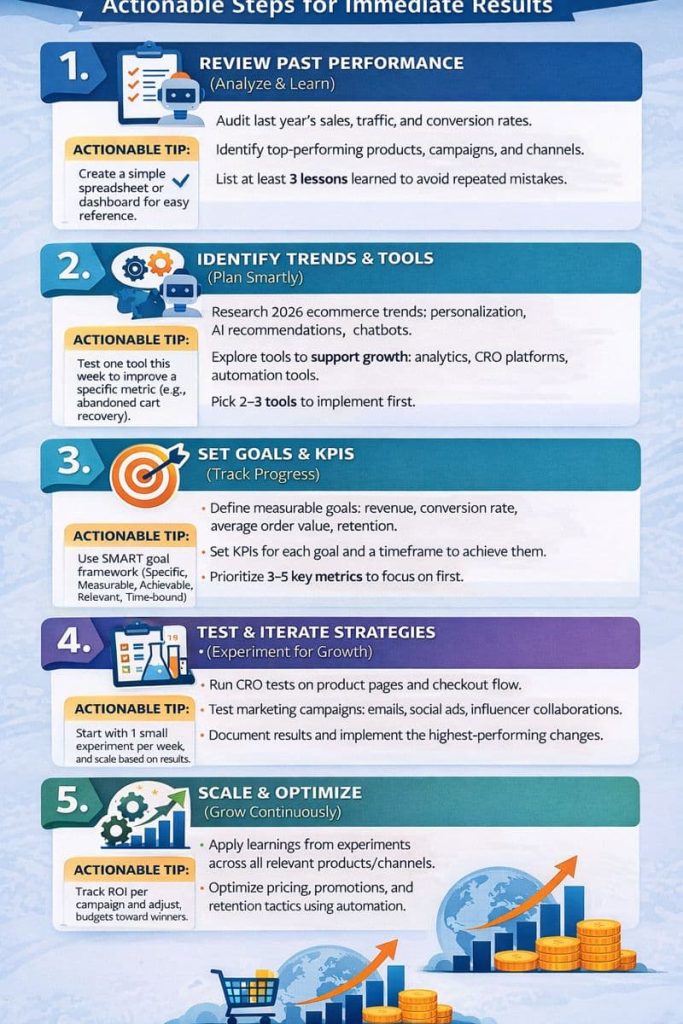
What’s Your 2026 Ecommerce Growth Plan?
Check the quick, actionable steps you can take now (in 2026) to implement your eCommerce growth strategy and boost your store sales:
How WooCommerce Store Owners Can Scale Faster with Smart Discounts?
For WooCommerce store owners, pricing flexibility often determines how well growth strategies scale. Strategic discounts encourage conversions, increase order values, and support retention when implemented thoughtfully.
This is where Discount Rules for WooCommerce – Pro(by Flycart) becomes invaluable. The plugin enables advanced discount logic based on cart value, product combinations, user roles, and purchase history.
As a result, store owners can execute complex ecommerce growth tactics without custom development.
Whether you’re running volume discounts, personalized offers, or seasonal campaigns, the plugin aligns seamlessly with a scalable ecommerce growth strategy. It supports experimentation while maintaining control over margins.
By integrating smart discounting into your WooCommerce store, growth becomes structured, measurable, and repeatable, exactly what scaling brands need.
Plan. Test. Grow. Scale your WooCommerce store confidently by offering advanced personalized discounts with Discount Rules for WooCommerce – Pro and boost sales today!
Conclusion: Turning Strategy into Sustainable Ecommerce Growth
Building a scalable ecommerce growth strategy requires clarity, discipline, and adaptability.
Rather than chasing isolated wins, successful brands align customer insights, pricing, marketing, and retention into one cohesive system.
As markets evolve, strategies must evolve too. Continuous learning, experimentation, and optimization ensure that growth remains sustainable. For WooCommerce store owners, leveraging the right tools further accelerates progress.
With a structured approach and the right support, ecommerce growth becomes predictable, profitable, and ready to scale.
Also Read:
- 10 B2C Ecommerce Trends That Reduce Cart Abandonment
- Top 5 Ecommerce B2B Trends You Need to Know in 2026
- 10 Helpful AI Tools for eCommerce Stores to Boost Revenue
Frequently Asked Questions
The four pillars typically include customer acquisition, retention, revenue optimization, and operational scalability. Together, they support sustainable business growth.
The 4 C’s are Customer, Cost, Convenience, and Communication. They shift focus from products to customer-centric decision-making.
The 5 C’s include Company, Customers, Competitors, Collaborators, and Context. They help analyze internal and external growth factors.
The 5 P’s are Plan, Ploy, Pattern, Position, and Perspective. They offer different lenses for strategic thinking.
The 7 C’s commonly include Clarity, Capability, Capacity, Commitment, Communication, Coordination, and Control.
The stages are startup, growth, expansion, maturity, and renewal or exit. Each stage requires different strategic priorities.